Keycloak experimental AuthZEN Support
May 20 2026 by Ryan Emerson
We are excited to announce that from 26.7.0, Keycloak will include experimental support for the OpenID AuthZEN Authorization API 1.0 specification. This allows Keycloak to act as a Policy Decision Point (PDP), exposing its authorization capabilities through a standardized API that any Policy Enforcement Point (PEP) can consume.
You can try this now with the Keycloak nightly release.
Why AuthZEN?
Authorization has long been fragmented, with competing systems defining their own protocols for answering the same fundamental question: "Can this subject perform this action on this resource?". This means applications are tightly coupled to whichever authorization backend they choose, and swapping providers requires rewriting integration code.
AuthZEN changes this by defining a single, vendor-neutral API between the component that asks (the PEP) and the component that decides (the PDP). It is, in many ways, what OpenID Connect did for authentication — but for authorization.
With AuthZEN:
-
No more vendor lock-in — your application speaks one API regardless of the PDP behind it.
-
RBAC, ABAC, and ReBAC under one roof — different policy models can answer the same request format, enabling true interoperability across authorization paradigms.
-
Centralized, externalized authorization — policy logic lives in the PDP, not scattered across application code, making it easier to audit and update.
-
Simpler integration — a clean REST API with a minimal request/response model replaces complex, implementation-specific SDKs.
A growing ecosystem
OpenID AuthZEN Interop demonstrates that over a dozen independently-developed PDPs can be used interchangeably by the same PEP without changing a single line of application code. By adding AuthZEN support, Keycloak joins this ecosystem and lets you leverage your existing Keycloak policies through the same standardized API used by every other AuthZEN-compatible PDP.
How it works
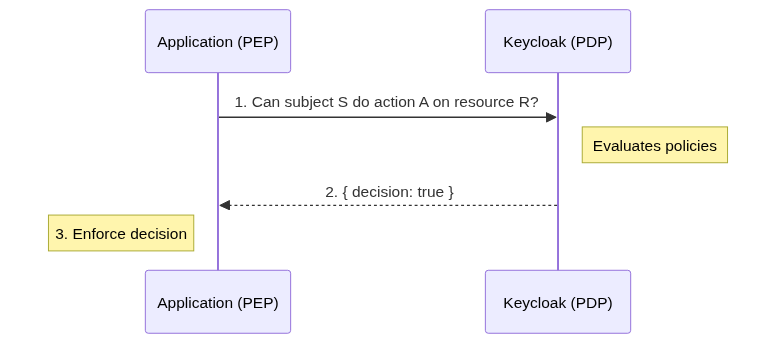
The interaction between your application and Keycloak follows the standard PEP / PDP pattern defined by AuthZEN:
-
Your application (the PEP) sends an authorization request to Keycloak over the AuthZEN Evaluation API, identifying a subject, an action, and a resource.
-
Keycloak (the PDP) evaluates the request against its configured authorization policies and returns a simple decision:
trueorfalse. -
Your application enforces the decision — granting or denying access accordingly.
Keycloak also supports the Evaluations API for batching multiple authorization checks into a single request, reducing round-trips when your application needs to check several permissions at once.
A quick walkthrough
Getting started takes just a few steps:
-
Start Keycloak with the
authzenfeature enabled. -
Configure a realm with users, roles, and an authorization-enabled client that defines your resources, scopes, and policies.
-
Discover the endpoints by querying the
.well-known/authzen-configurationpath for your realm — this returns the Evaluation and Evaluations API URLs so your PEP does not need to hardcode them. -
Obtain an access token for the authorization-enabled client using a standard OAuth2 client credentials grant.
-
Send an evaluation request with a subject, action, and resource — Keycloak returns
{"decision": true}or{"decision": false}.
Keycloak supports looking up subjects by username, UUID, or email, giving your PEP flexibility in how it identifies users.
Try it out
We have also prepared a hands-on playground that walks you through the full setup with working examples of both the Evaluation and Evaluations API:
Feedback welcome
AuthZEN support in Keycloak is currently an experimental feature, and we would love to hear from the community as we shape its future. Download the Keycloak nightly release and try it out.
Please share your experiences, suggestions, and feature requests on the AuthZEN GitHub discussion or join the conversation on the Keycloak mailing list. Your input will directly influence how we evolve AuthZEN support in future releases.