Multi-Cluster v2 and Stateless Mode now in Preview
July 17 2026 by Alexander Schwartz
Starting with Keycloak 26.7, the stateless feature is available as a preview. It fundamentally simplifies how Keycloak handles volatile data — authentication sessions, action tokens, and brute-force counters move from embedded or external Infinispan caches to the database. The result: Keycloak deployments that are easier to operate, more resilient, and ready for multi-cluster setups without an external Infinispan cluster.
Read on to learn more, and ask questions in our upcoming live Q&A event on Jul 21!
The problem with the current approach
A multi-cluster setup becomes necessary when no transparent networking between two sites is available for Keycloak’s embedded Infinispan to form a single cluster — for example, when sites are in different availability zones or data centers without a shared network layer.
Running Keycloak in such a multi-cluster setup today requires significant infrastructure beyond Keycloak itself. Without the stateless feature, the architecture depends on an external Infinispan cluster with cross-datacenter replication channels, dedicated monitoring to detect and handle Infinispan failover, and operational procedures for failback. It was tied to specific environments like Kubernetes and AWS, and using it in other environments would require significant work to adapt it.
Even in single-cluster deployments, Infinispan clustering introduces operational overhead: rebalancing data in distributed caches when a node is lost or restarted, and transient failures in login flows if a node unexpectedly disappears. In large installations, the login failure cache can grow significantly, consuming substantial memory and causing long rebalancing times when nodes join or leave the cluster. While distributed caches replicate data across at least two nodes — so individual node failures do not lose data — a full cluster restart during minor upgrades resets volatile state such as in-progress authentication sessions and brute-force counters.
What changes with stateless mode
When you enable the stateless feature, Keycloak stores volatile data in the database instead of distributed Infinispan caches:
-
Authentication sessions — users mid-login no longer lose progress during full cluster restarts on minor upgrades.
-
Action tokens — email verification links, password reset tokens, and OAuth codes persist across cluster restarts.
-
Login failure counters — brute-force detection remains effective even when the entire cluster is restarted.
Realm and authorization data continues to be cached locally in each Keycloak node for fast reads. Within a cluster, JGroups handles immediate cache invalidation when realm data changes. Between clusters, a database outbox pattern propagates invalidation messages via polling, with a default interval of 100 milliseconds.
No Infinispan traffic happens between nodes during OIDC or SAML request processing, eliminating transient failures if a node fails unexpectedly. JGroups is still used for intra-cluster realm cache coordination, but it is not touched during authentication flows.
When to use stateless mode
Stateless mode benefits both single-cluster and multi-cluster deployments.
Single cluster
-
Durable sessions: Volatile data survives full cluster restarts during minor upgrades.
-
Simpler operations: No more large in-memory caches, rebalancing delays, or transient failures when nodes are added or removed.
-
Trade-off: Approximately 8-10 milliseconds of additional latency per authentication interaction, negligible for interactive login flows. Database CPU load and IOPS can increase by roughly a factor of two.
Multi-cluster
All single-cluster benefits apply, plus:
-
No external Infinispan cluster: Eliminates a separate Infinispan deployment, its monitoring, and failover/failback procedures.
-
Session failover: Because sessions are stored in the synchronously replicated database, users stay logged in when traffic fails over to a surviving site.
-
Environment-agnostic: The architecture is not tied to Kubernetes or a specific cloud provider.
-
Automatic failover: A load balancer can detect site failures and redirect traffic to the surviving site. If database failover is required, a short downtime might occur until the new writer instance becomes available.
-
Prerequisite: A synchronously replicated database and a low-latency network between sites (less than 5 ms suggested, below 10 ms required for database round-trip).
All user and realm data is replicated synchronously, so persistent data is not lost during failover. Session data is replicated asynchronously by default if the database supports it to reduce request latency.
Architecture at a glance
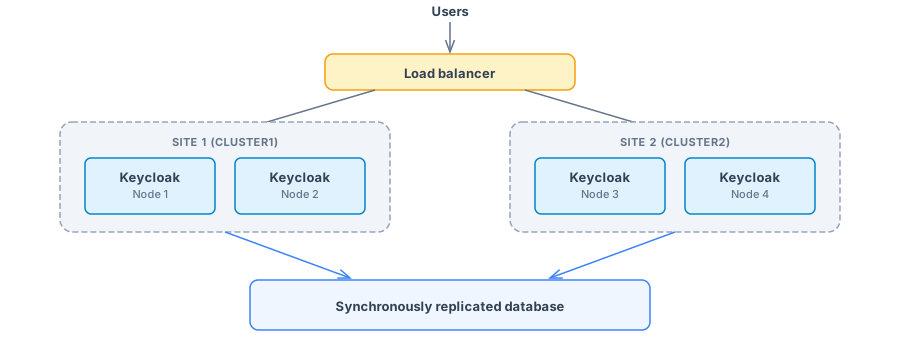
Figure 1. Multi-cluster v2: Two independent Keycloak clusters connected only through a synchronously replicated database
A multi-cluster v2 deployment consists of:
-
Two or more independent Keycloak cluster deployments, each running in a different site
-
A highly available, synchronously replicated database (tested with Amazon Aurora PostgreSQL)
-
An external load balancer distributing traffic across clusters (tested with AWS Global Accelerator)
All entities — users, realms, clients, user sessions, and now also authentication sessions and login failures — are stored in the database. Realm data is cached locally in each Keycloak node. Cross-cluster cache invalidation is handled through a database queuing table, not through direct network connections between clusters.
Current limitations
-
Single-region only: Synchronously replicated databases are generally not available across multiple regions.
-
Database latency matters: Because synchronous replication defers responses until data reaches the other site, latency between database nodes directly affects Keycloak response times. Multiple database interactions per request amplify this effect.
-
Planned outages: Patch upgrades are zero-downtime. Minor and major upgrades require shutting down all sites except one, upgrading that site, then deploying the new version to the remaining sites.
Migrating existing installations
If you are running a multi-cluster v1 deployment, migrating to v2 is straightforward: enable the stateless feature flag, then remove the external Infinispan cluster, its configuration, the AWS Lambda, and the Prometheus monitoring and alerts that triggered the AWS lambda.
As all user sessions are stored in the database already in multi-cluster v1 mode, users will still be logged in after the migration to multi-cluster v2. Information about in-progress logins and login failure counters is lost during the upgrade.
Single-cluster deployments can be upgraded to stateless mode by enabling the stateless feature flag and adding the cluster name parameter in a similar way. If you have persistent user sessions enabled (which is the default for single clusters), users will still be logged in when migrating to multi-cluster v2.
Getting started
Start Keycloak with the stateless feature enabled:
bin/kc.sh start \
  --features=stateless \
  --spi-cache-embedded--default--cluster-name=CLUSTER1 \
  --db=postgres --db-url=jdbc:postgresql://db-host/keycloak \
  --db-username=keycloak --db-password=<password>
For a second cluster, use a different cluster-name:
bin/kc.sh start \
  --features=stateless \
  --spi-cache-embedded--default--cluster-name=CLUSTER2 \
  --db=postgres --db-url=jdbc:postgresql://db-host/keycloak \
  --db-username=keycloak --db-password=<password>
Full documentation is available in the multi-cluster v2 guide.
Feedback welcome
Stateless mode is currently a preview feature, and we would love to hear from the community as we shape its future. Try it with Keycloak 26.7.
Please share your experiences, suggestions, and feature requests on the GitHub discussion. Your input will directly influence how we evolve this feature toward supported status.